
Most companies say people are their most valuable asset. Far fewer plan how they'll find those people with the same care they give to sales, finance or expansion. That gap is where talent acquisition comes in.
In a competitive market like Indonesia's, where experienced managers and specialists are often hired away within months, waiting until a seat is empty is expensive. This guide explains what talent acquisition is, how it differs from recruitment and HR, how the process works, and why leading companies treat it as a core business strategy rather than an administrative task.
What Is Talent Acquisition?
Talent acquisition (TA) is the long-term, strategic process of finding, attracting, assessing and hiring the people a business needs to reach its goals. It looks beyond today's vacancy to the skills the company will need in one, three or five years, and builds the relationships, pipelines and employer brand to secure them.
In practice, talent acquisition covers workforce planning, talent mapping, employer branding, sourcing, assessment, offers and onboarding. A talent acquisition team or specialist owns this work, usually within or alongside HR.
Talent Acquisition vs Recruitment
The two terms are often used interchangeably, but they aren't the same.
Talent acquisition | Recruitment | |
|---|---|---|
Focus | Long-term talent strategy | Filling current vacancies |
Timing | Proactive, before roles open | Reactive, when a role opens |
Candidates | Builds talent pools and pipelines, including passive candidates | Mostly active applicants |
Scope | Planning, branding, sourcing, assessment, onboarding | Advertising, screening, interviewing |
Measure of success | Quality of hire and retention | Time to fill |
Recruitment is part of talent acquisition. Talent acquisition is the strategy that makes recruitment faster and better.
Is Talent Acquisition Part of HR?
Usually, yes. In most Indonesian companies, talent acquisition sits within the HR department, reporting to the HR director. Larger companies often run it as a specialist team with its own head of talent acquisition, working closely with business leaders. HR covers the whole employee life cycle, including payroll, employee relations, training and compliance. Talent acquisition focuses on the first stage: bringing the right people in.
Why Talent Acquisition Should Be a Core Business Strategy
When talent acquisition is treated as an admin function, hiring starts when someone resigns and ends when a seat is filled. When it's treated as strategy, it's planned alongside growth targets. That shift pays off in four ways:
- Growth isn't held back by empty seats. A new plant, product line or regional office needs leaders and specialists in place on day one. Planning talent with the business plan prevents months of delay.
- Better hires, lower cost. A bad hire costs far more than the salary: lost output, team disruption and the cost of hiring again. A structured process reduces that risk. See the hidden cost of a bad hire.
- A stronger employer brand. Professionals research employers before they apply. Companies that show their culture and career paths attract better candidates and pay less to do it.
- A lasting competitive advantage. The right people bring expertise, ideas and leadership that competitors can't easily copy.
Recruiter's Insight: The companies we see hiring best in Indonesia don't have bigger HR teams. Their business leaders treat hiring as part of their own job, not something HR does for them.
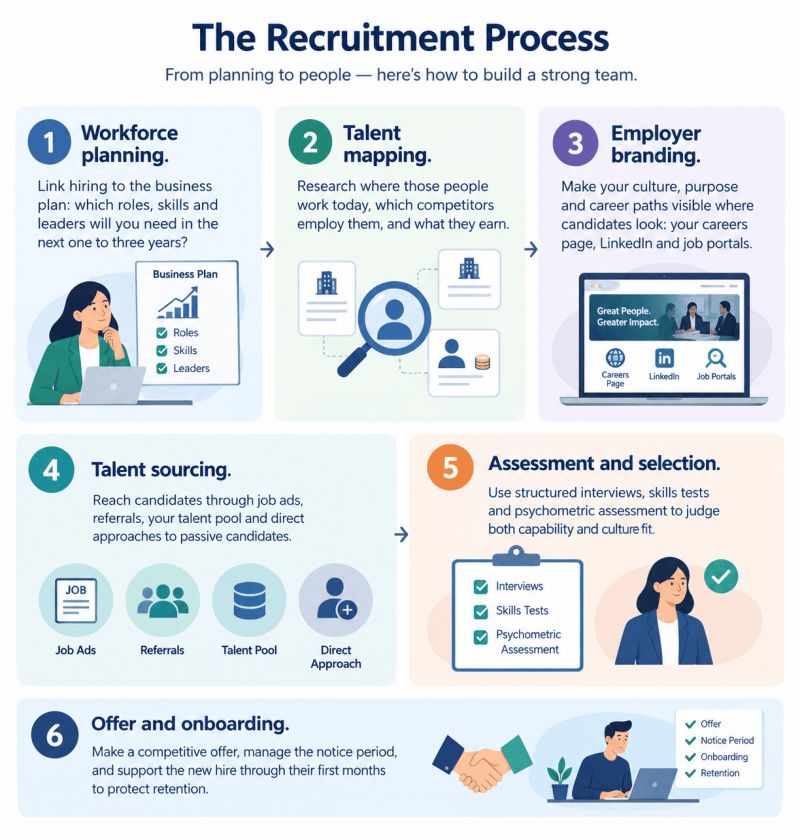
The Talent Acquisition Process in 6 Steps
- Workforce planning. Link hiring to the business plan: which roles, skills and leaders will you need in the next one to three years?
- Talent mapping. Research where those people work today, which competitors employ them, and what they earn.
- Employer branding. Make your culture, purpose and career paths visible where candidates look: your careers page, LinkedIn and job portals.
- Talent sourcing. Reach candidates through job ads, referrals, your talent pool and direct approaches to passive candidates.
- Assessment and selection. Use structured interviews, skills tests and psychometric assessment to judge both capability and culture fit.
- Offer and onboarding. Make a competitive offer, manage the notice period, and support the new hire through their first months to protect retention.
Talent Acquisition Strategies That Work
Build a talent pool and pipeline
A talent pool is a group of qualified people you've already met or identified, including past finalists and strong candidates who weren't ready to move. Keeping in touch means your next search starts with a shortlist, not a blank page.
Use talent mapping for critical roles
Talent mapping shows who the top performers are across your industry before you need them. It's essential for leadership and niche roles where only a handful of people fit.
Invest in employer branding
Candidates compare employers the way customers compare brands. Share real stories from your team, be clear about career growth, and make sure your reviews and social media match what you promise.
Deliver a strong candidate experience
Fast feedback, clear steps and respectful communication matter, especially for senior candidates who are often in several processes at once. A slow or careless process loses good people to faster competitors.
Use data and AI carefully
AI in talent acquisition can speed up screening, scheduling and sourcing. Use it to save time on volume tasks, but keep people in charge of assessment and final decisions, and check tools for bias.
How to Measure Talent Acquisition
What gets measured gets managed. Track a few metrics consistently:
Metric | What it tells you |
|---|---|
Time to fill | How long a role stays open, from approval to accepted offer |
Quality of hire | How new hires perform and are rated after 6–12 months |
First-year retention | Whether you're hiring people who stay |
Offer acceptance rate | Whether your offer and process are competitive |
Cost per hire | Total hiring cost divided by number of hires |
Source of hire | Which channels bring your best people |
Quality of hire and retention matter most. A role filled fast with the wrong person costs more than one filled right a few weeks later.
Talent Acquisition Roles
- Talent acquisition specialist: runs searches day to day: sourcing, screening, interviewing and coordinating offers.
- Talent acquisition manager: leads the team, sets hiring strategy with business leaders and owns the metrics.
- Head of talent acquisition: senior leader responsible for workforce planning and employer brand across the company.
[THI to add: typical monthly salary ranges for these roles in Jakarta, from THI's own placement data.]
When to Bring In a Talent Acquisition Partner
Even strong in-house teams need support at times. Consider an external partner when:
- You're hiring senior leaders. Executive search reaches passive candidates your team can't approach directly. See what executive search is.
- You're entering Indonesia and don't have a local HR team or network yet.
- You need volume quickly, such as a new site or business unit, and recruitment process outsourcing (RPO) can scale faster than hiring more recruiters.
- The role is confidential or very niche.
Conclusion
Talent acquisition is no longer an administrative function. It's how companies make sure growth plans have the people to deliver them. By linking hiring to business strategy, building talent pools before roles open, and measuring quality rather than speed alone, you turn talent into a catalyst for growth instead of a constant scramble.
In a world where people are a company's most valuable asset, a thoughtful talent acquisition strategy is one of the best investments a business can make.