Every company eventually reaches a point where hiring the wrong leader costs more than taking longer to hire the right one. A poor executive appointment doesn't affect one department. It slows growth, unsettles teams, weakens customer confidence and can cost millions in lost productivity and replacement costs.
That's why companies rarely rely on job ads to hire CEOs, directors, country managers or plant managers. They use executive search. This guide explains what executive search is, how the process works, what it costs, and how to choose the right executive search firm in Indonesia.
What Is Executive Search?
Executive search is a specialised recruitment service for senior and business-critical roles. Instead of advertising a vacancy and waiting for applications, executive search consultants research the market, map the leaders who fit the role, and approach them directly and confidentially.
The goal is simple: find the best leader available, not just the best person who applied.
This matters because most high-performing executives aren't looking for a new job. They're busy succeeding where they are, and they won't see your job ad. Executive search reaches these passive candidates, which gives you a much larger and stronger pool than advertising alone.
Executive Insight: Companies rarely fail because they can't find candidates. They fail because they hire the wrong leader.
Executive Search vs Traditional Recruitment
Both help companies hire, but they solve different problems.
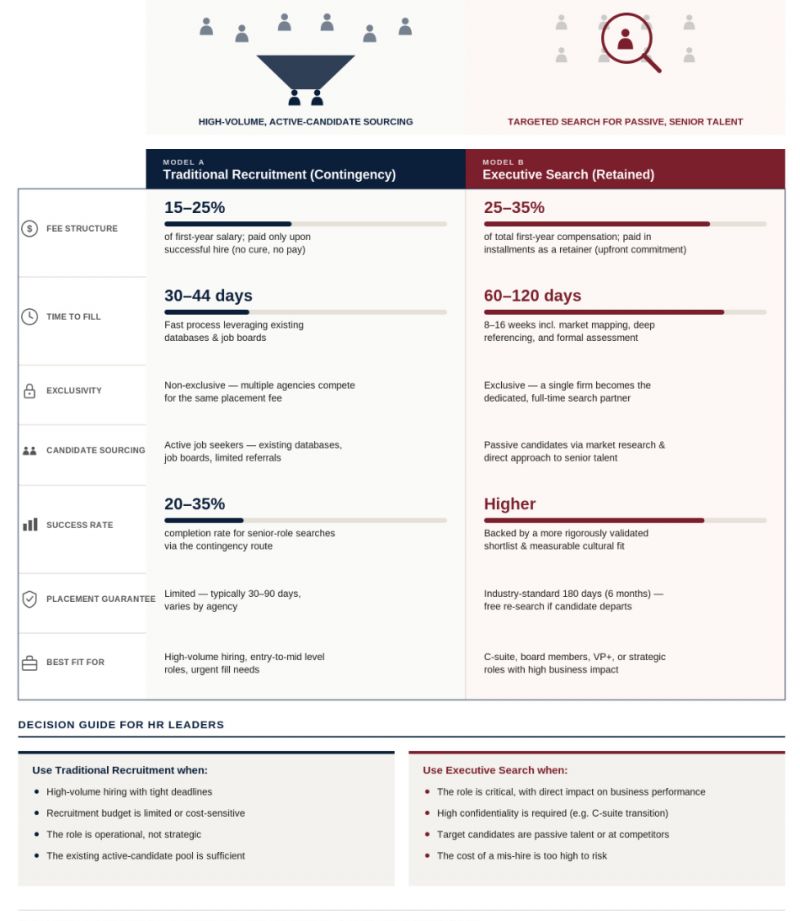
Traditional recruitment works well for operational hiring. Executive search is designed for appointments that shape the business.
[Image: Executive search vs traditional recruitment comparison]
Executive Search vs Headhunter: Is There a Difference?
In Indonesia, "headhunter" is often used for any recruiter who approaches candidates directly. Executive search is the most structured form of headhunting: a defined search process, market research, in-depth assessment and, usually, an exclusive engagement with the client. Every executive search consultant is a headhunter, but not every headhunter runs a full executive search.
When Should Companies Use Executive Search?
Executive search makes sense when the hire will shape results for years. Typical roles include:
- CEO, CFO, COO and CHRO
- Country manager and general manager
- Commercial, sales and operations directors
- Plant managers and other site leaders
It is also the right approach when:
- You're entering Indonesia and need a local leader who knows the market, regulators and talent landscape.
- The search is confidential, for example replacing an executive who hasn't left yet.
- You're planning succession and want to see who's available before a role opens.
- The talent pool is small, such as niche technical or industry-specific leadership.
- You're building a new leadership team for a new business unit or market.
How the Executive Search Process Works
A structured search usually follows six steps:
- Briefing. The consultant meets the hiring leaders to define the role, the business challenge it must solve, the leadership profile and the package.
- Market mapping. The team researches companies and competitors to identify every executive who could fit, not just those who are looking.
- Approach. Consultants contact shortlisted leaders confidentially, explain the opportunity and assess their interest and motivation.
- Assessment. Candidates go through in-depth interviews on track record, leadership style and culture fit, often with psychometric tools and reference checks.
- Shortlist and interviews. The client meets a small shortlist, typically three to five candidates, with a written assessment for each.
- Offer and onboarding. The consultant helps negotiate the offer, manages the resignation and notice period, and stays in touch through the first months.
Executive Insight: Most of a search's value is created in steps 1 and 2. A vague brief or a narrow market map means the right leader is never approached.
How Much Does Executive Search Cost, and How Long Does It Take?
Executive search firms charge in one of two ways:
- Retained search: the client pays a fee in stages (at the start, at shortlist and at placement). The firm works exclusively on the role, which suits senior and confidential searches. Internationally, retained fees are commonly around one third of the executive's first-year cash compensation.
- Contingency search: the client pays only if a candidate is hired. It suits mid-management roles, but the firm may work several roles at once and with less depth.
At Talent Hunts Indonesia, executive search fees are [THI to confirm: typically X–Y% of first-year annual compensation], depending on seniority and scope.
A typical search takes [THI to confirm: X–Y weeks] from briefing to signed offer. In Indonesia, add the candidate's notice period, usually one to three months for senior leaders, before they start.
How to Choose an Executive Search Firm in Indonesia
The firm you choose will represent your company to the leaders you most want to hire. Ask these questions before you sign:
- Do they know your industry? Ask for recent searches at a similar level and in a similar sector.
- Who will actually run the search? Make sure the senior consultant you meet stays involved, not only a junior researcher.
- How do they assess candidates? Look for structured interviews, leadership assessment and real reference checks, not just CV matching.
- How will they protect confidentiality? This matters most for replacement and market-entry searches.
- What happens if the hire doesn't work out? Ask about their replacement guarantee.
- Are they part of a professional body? Membership of an association such as APRESI signals a commitment to recruitment standards.
Common Executive Hiring Mistakes
- Relying on job portals to attract senior leaders who aren't looking
- Hiring for technical expertise alone and ignoring leadership ability
- Rushing the process because the seat is empty
- Skipping culture-fit assessment
- Comparing too few candidates
Each of these raises the risk of a costly mis-hire; see the hidden cost of a bad hire.
Why Companies Choose Talent Hunts Indonesia
Talent Hunts Indonesia is a founding member of APRESI, the Indonesian Association of Recruitment and Executive Search Companies. We have served 300+ businesses across 30+ industries and placed 500+ candidates, from plant managers to country managers and CEOs. Our searches are led by consultants with decades of executive search experience at multinational firms in Jakarta.
We combine market mapping, structured leadership assessment and honest advice, so every shortlisted candidate has the experience, leadership ability and cultural fit to succeed long term. Learn more about our approach.
Conclusion
Executive search is no longer only for multinationals. It's how any company reduces the risk of its most important hires: by reaching the best leaders in the market, assessing them properly, and closing the offer with expert support. If your next hire will shape the future of your business, an executive search is likely the smartest investment you'll make.