
Short answer: not really. Legitimate headhunters are hired and paid by employers, not by job seekers. You cannot pay one to find you a job, and anyone who asks you for money to put you forward is not working like a real headhunter. What you can do is make yourself easy for headhunters to find, and know how to work with them when they call.
We say this as a headhunter. Talent Hunts Indonesia is an executive search firm in Jakarta and a founding member of APRESI, the Indonesian association of recruitment and executive search firms. We have placed more than 500 candidates for over 300 clients across 30+ industries, and our network covers more than 10,000 professionals in 10+ countries.
Below is how the model works from the candidate's side, and how to make it work for you.
Can You Hire a Headhunter to Find You a Job?
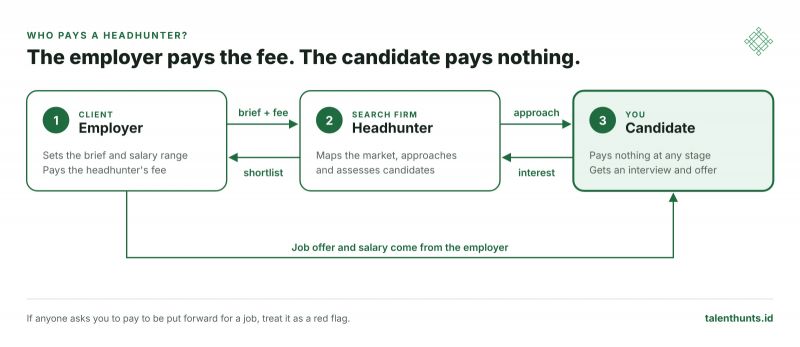
A headhunter's client is the employer, not the candidate. The company pays the headhunter to fill a specific role, usually a percentage of the hire's first-year salary. Candidates pay nothing. You cannot buy a headhunter's search, but you can make sure you are the person they find.
The confusion is understandable. The word "hire" suggests you can engage one the way you would hire a lawyer or an accountant. In recruitment, though, the money moves the other way. The employer has a vacancy, the headhunter is paid to fill it, and you are the talent they are looking for.
How Headhunters Actually Work
Every search starts with the employer, not the candidate. A company decides it needs, say, a finance director or a head of engineering. It briefs a headhunter on the role, the team, the salary range and the kind of person who will succeed. That brief defines who the headhunter looks for.
From there, the headhunter maps the market: which companies employ people with the right experience, who holds similar roles, and who might be open to a move. Most of the people they approach are not job hunting. They are passive candidates who are doing well where they are.
Headhunters are paid in one of two main ways, and both come from the employer:
- Contingency. The firm is paid only if the client hires a candidate it introduced. These searches are often non-exclusive, so several agencies may work the same role.
- Retained. The client pays part of the fee upfront for a dedicated, usually exclusive search, then the rest in stages. This is the standard model for executive search, C-level roles and confidential replacements.
Fees typically range from about 15% to 35% of the hire's first-year salary, depending on seniority and how hard the role is to fill. You can see how headhunter fees work in Indonesia in more detail. The point for you as a candidate is simple: the fee is the employer's cost, and it is never deducted from your salary.
Headhunter vs Career Coach vs Paid "Job Search Agent"
Some people searching for a paid headhunter are really looking for a different service. Three kinds of help exist, and only one of them is paid by the employer.
Headhunter | Career coach | Paid job search agent | |
|---|---|---|---|
Who pays | The employer | You | You |
Who they work for | The hiring company | You | You |
What you get | An introduction to a specific, real vacancy | Advice on direction, CV, interviews and negotiation | Help applying: CV rewrites, applications sent for you, outreach to recruiters |
Access to unadvertised roles | Yes, the client's roles | No | Rarely |
Can guarantee a job | No | No | No, so be wary of any that claim to |
Best for | Mid to senior professionals whose profile matches open roles | Career changers and anyone unsure of their next step | Busy job seekers who want admin help with applications |
A good career coach can be worth paying for, especially if you are changing industries or preparing for a leadership role. Just be clear about what you are buying: advice and preparation, not access to jobs. Only the employer-paid headhunter brings you an actual vacancy.
When a Headhunter Can Help Your Career
Headhunters are not the right channel for every job search. For entry-level or high-volume roles, employers usually advertise and hire directly. Headhunters add the most value in a few situations:
- Senior roles. Director, head-of and C-level positions are often filled through executive search and never advertised. If you are at or near that level, being known to the right headhunters gives you access to a market you cannot see on job boards.
- Niche or scarce skills. Specialists in areas such as data and AI, energy, mining, finance or regulated industries are hard to find. Employers pay headhunters to locate them, so those profiles get called often.
- Confidential moves. Companies replacing a sitting executive, or building a team before an announcement, use headhunters to search quietly. On your side, a headhunter can explore an opportunity for you without your current employer hearing about it.
- Moving into or within Indonesia. International companies entering Indonesia, and Indonesian professionals returning from overseas, often rely on a local search firm that knows the market, salary levels and expectations.
- Negotiation and offer stage. A headhunter knows the client's budget and what the role is worth. They can help you negotiate a fair package, manage your notice period and handle a counteroffer from your current employer.
In short, a headhunter helps most when your experience is already in demand. If you are early in your career or changing fields, a career coach and a strong direct job search will usually do more for you.
How to Get Noticed by Headhunters
Since you cannot hire a headhunter, the next best thing is to be easy to find and easy to recommend. A few habits make the biggest difference:
- Keep your LinkedIn profile current. Headhunters search LinkedIn by job title, skills, industry and location. Use the title the market uses and list measurable results. If you set "Open to work" to recruiters only, LinkedIn tries to hide it from recruiters at your own company, but it cannot guarantee that.
- Register with specialist agencies. Find two or three firms that recruit in your field and level, and submit your CV to their database. When a matching role opens, consultants search their own database first.
- Make your CV easy to scan. A headhunter reads dozens of profiles a day. Lead with your current role, scope and results. If yours needs work, here is how to write a resume recruiters actually read.
- Respond quickly, even to say no. A short, polite reply keeps you on the headhunter's list for the next role. Ignoring messages usually takes you off it.
- Be clear about salary and notice period. Headhunters need your current package, your expectations and how soon you could start. Clear, honest numbers help them match you to the right roles and avoid wasted interviews.
We cover this in more depth in our article on getting noticed by a headhunter. The video below also explains how the model works from a candidate's point of view.
[Video embed: "Hiring Headhunters to Find You a Job | How This Works" (The Companies Expert): https://www.youtube.com/watch?v=ZnUB0H9aCkw]
Red Flags: Agencies That Ask Candidates to Pay
Because the employer pays the fee, a request for money from a candidate is the clearest warning sign in recruitment. Fake job offers are a common scam in Indonesia, and many follow the same pattern. Be careful if an "agency" or "headhunter":
- Asks for a registration, placement, processing or "administration" fee before or after an interview
- Requires you to pay for training, a medical check, a uniform or travel to a selection event
- Promises a guaranteed job, or a salary far above the market rate for your experience
- Contacts you from a free email address or personal number and cannot name the client or the role
- Pressures you to decide or pay quickly, or asks for your bank details or ID before any interview
- Has no verifiable office, website or company registration
A legitimate headhunter may ask for your CV, references, a video call or a meeting. They may ask about your current salary. They will never ask you for money. If you are unsure, look the firm up, check that it is a real registered company, and see whether it belongs to an industry body such as APRESI.
What Happens When a Headhunter Calls You
When a headhunter does reach out, the process usually runs in four stages. Here is how it works at Talent Hunts Indonesia, from the candidate's side.
1. The first call. A consultant introduces the opportunity, often without naming the client at first if the search is confidential. They describe the role, the industry and the rough package, and ask whether you are open to hearing more. This is a two-way conversation, so ask why the role is open and what the team is like.
2. Assessment. If you are interested, the consultant interviews you in more depth: your experience, results, motivation to move, salary expectations and notice period. At THI we assess candidates with the HUNTS Framework™, which looks at the person behind the CV as well as their track record. Be honest here. The consultant can only represent you well if they know the full picture.
3. Client interviews. If you fit the brief, the headhunter presents you to the client with a summary of their assessment. You then interview with the employer, usually HR first and then the hiring manager. Your consultant prepares you beforehand and passes on the client's feedback afterwards, which is something you rarely get when you apply directly.
4. Offer and onboarding. When the client wants to hire you, the headhunter handles the offer: the package, the start date and any negotiation. They also help you through your resignation, including a possible counteroffer from your current employer, and stay in touch through your first months in the new role.
If the role is not right for you, say so. A clear "not now, but this is what I'm looking for" keeps the door open for the next search.
Conclusion
You cannot hire a headhunter to find you a job, and you should not have to. In a legitimate search the employer pays, the headhunter finds and assesses, and the candidate pays nothing at any stage. Your job is to be the person they find: a current profile, a clear CV, a quick reply and honest numbers on salary and notice period.
If you are a mid-level or senior professional in Indonesia, the easiest place to start is to submit your CV to Talent Hunts Indonesia so our consultants can match you to upcoming searches. You can also browse our open jobs and apply to any role that fits.