If you work in HR or are looking for a job, you may have seen roles such as OD Specialist, OD Manager or Head of Organizational Development. Many people, including HR professionals, are not sure what these roles actually do, or how OD differs from the rest of HR.
This article explains what organizational development is, its goals, the OD process, common interventions, how OD compares with HRD, and what OD specialists and managers do day to day. It also shows how OD connects with change management and leadership.
Talent Hunts Indonesia is a founding member of APRESI, the Indonesian Association of Recruitment and Executive Search Companies. We have worked with more than 300 clients across more than 30 industries, including on HR and OD roles from specialist to head of department.
What Is Organizational Development?
Organizational development (OD) is a planned, organization-wide effort to improve how an organization works, through changes to its structure, culture, processes and people, based on evidence about what is and is not working. In Indonesian it is usually called pengembangan organisasi.
The classic definition comes from Richard Beckhard (1969), who described OD as an effort that is:
- planned;
- organization-wide;
- managed from the top;
- aimed at increasing organizational effectiveness and health;
- carried out through planned interventions in the organization's processes, using knowledge from the behavioural sciences.
In simple terms, OD treats the organization as a system. Instead of fixing one problem at a time, it looks at how strategy, structure, culture, leadership and ways of working fit together, then changes what is holding the organization back.
Goals of Organizational Development
OD aims to make the organization better at reaching its goals, now and as conditions change. Its main goals are:
- Align the organization with its strategy. Make sure the structure, roles and processes support where the business is going.
- Improve effectiveness and productivity. Remove duplicated work, unclear responsibilities and slow decision-making.
- Build a healthy culture. Encourage trust, collaboration and open communication.
- Strengthen leadership. Develop leaders who can run teams well and lead others through change.
- Increase the ability to change. Help the organization adapt to new technology, markets and regulations without losing momentum.
- Raise engagement and retention. People stay longer in organizations where roles are clear and work makes sense.
The Organizational Development Process
Most OD work follows an action research cycle: understand the problem with data, act on it, check the results, then go round again. It is often described in five stages.
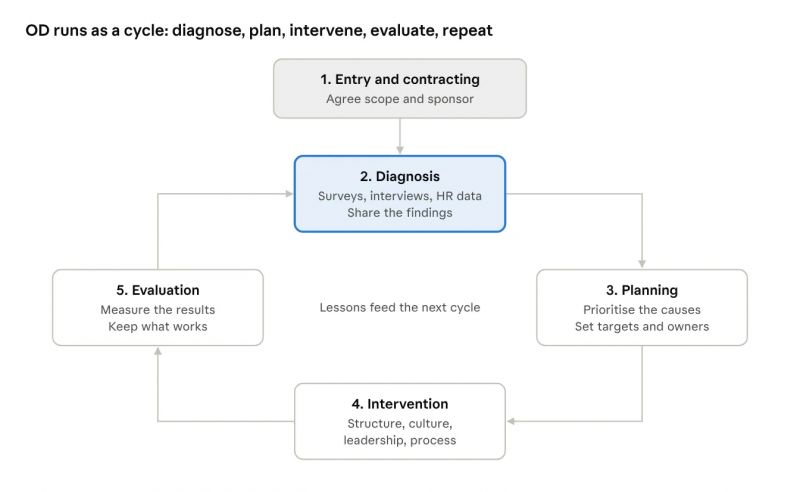
- Entry and contracting. The OD team and the leaders who sponsor the work agree on the problem to explore, the scope, the people involved and how success will be measured.
- Diagnosis. Collect data on what is really happening, through surveys, interviews, focus groups, process mapping and HR data such as turnover and engagement scores. Then share the findings with leaders and employees.
- Planning. Agree which problems matter most and design interventions that address their causes, not just the symptoms. Set targets, owners and a timeline.
- Intervention. Put the changes into action, for example a new structure, a leadership programme or a redesigned process. This is where change management matters most: people need to understand the reason, be supported and be trained.
- Evaluation and institutionalization. Measure whether the targets were met. Keep what worked by building it into policies, systems and performance measures, and feed the lessons into the next cycle.
The four core stages are diagnosis, planning, intervention and evaluation. Entry and contracting is the step that makes sure the work has a clear sponsor and mandate before it starts.
Examples of OD Interventions
An intervention is a planned action to fix a problem found in the diagnosis. Interventions usually fall into four areas.
1. Structure
Changing how work and responsibilities are divided.
- Redesigning the organization chart after a merger or a new strategy.
- Reducing layers of management to speed up decisions.
- Clarifying roles and decision rights, for example with a RACI matrix.
- Writing or updating job descriptions and the grading structure.
2. Culture
Changing the shared values and behaviours that shape how people work.
- Defining company values and the behaviours expected at each level.
- Running engagement surveys and acting on the results.
- Bringing two cultures together after an acquisition.
- Building the values into hiring, onboarding and performance reviews.
3. Leadership
Helping leaders run teams and lead change well.
- Leadership development programmes for new and senior managers.
- Coaching and 360-degree feedback.
- Succession planning for critical roles.
- Team-building for leadership teams that need to work better together.
4. Processes and ways of working
Improving how work flows between people and teams.
- Mapping and simplifying slow or duplicated processes.
- Improving how teams communicate, hold meetings and make decisions.
- Supporting the people side of new technology, such as a new HR system or AI tools.
Large interventions such as restructuring or digital transformation are also where OD overlaps with change management: OD decides what needs to change, and change management helps people adopt it.
OD vs HRD: What Is the Difference?
OD and HRD (human resource development) are closely related and often sit in the same HR department. The difference is the level they work at: HRD develops individuals, while OD develops the organization as a whole.
Aspect | Organizational development (OD) | Human resource development (HRD) |
|---|---|---|
Main focus | The organization as a system: structure, culture, processes, leadership | Individual employees: skills, knowledge, careers |
Typical question | Why is this organization not performing as it should? | What do our people need to learn to do their jobs better? |
Typical work | Organization design, culture change, engagement, change programmes, team effectiveness | Training, learning programmes, career development, competency frameworks |
Time horizon | Medium to long term, linked to strategy | Short to medium term, linked to roles and skills |
How success is measured | Organizational effectiveness, engagement, ability to change | Skills gained, training completion, individual performance |
Works most closely with | Board, senior leaders, all departments | Line managers, employees, training providers |
Is OD part of HR? In most companies, yes. OD usually sits within HR or human capital, reporting to the HR director. In some larger organizations it reports to the CEO or the strategy team, because its work affects the whole business. To understand where OD fits in the bigger picture, see our articles on human capital and HR strategy.
What Do OD Specialists and OD Managers Do?
Job titles vary between companies, but OD roles usually follow two levels.
OD Specialist
An OD specialist (sometimes called OD officer or OD analyst) runs the day-to-day work of OD projects. Typical responsibilities:
- Designing and analysing engagement and culture surveys.
- Preparing organization charts, job descriptions and job grading.
- Running workload analysis to work out how many people each unit needs.
- Mapping processes and helping teams simplify them.
- Supporting change programmes with communication and training materials.
- Preparing data and reports for HR and management.
Common requirements: a degree in psychology, management or a related field; 2 to 5 years in HR or OD; strong skills in data analysis, Excel and presentations; and familiarity with job analysis and grading methods.
OD Manager or Head of OD
An OD manager leads the OD agenda and works directly with senior leaders. Typical responsibilities:
- Translating business strategy into organization design and capability needs.
- Leading restructuring, merger integration and culture change programmes.
- Designing leadership development and succession planning with the learning team.
- Advising the board and directors on structure, headcount and change.
- Setting OD measures and reporting progress to management.
- Managing a team of OD specialists and external consultants.
Common requirements: 7 or more years in HR, with several years in OD, organization design or consulting; experience leading change across an organization; and the credibility to challenge senior leaders with evidence.
Because OD managers shape structure and culture, the wrong hire can set an organization back for years. Companies often look for candidates who have already led change in a similar business, and many of those candidates are not actively applying for jobs. If you are looking for an OD role yourself, see our current job openings.
Conclusion
Organizational development is how an organization improves itself in a planned way: it diagnoses what is holding the business back, designs changes to structure, culture, leadership and processes, and checks that they work. OD specialists do much of the analysis and design, while OD managers lead the agenda with senior leaders.
The success of OD depends heavily on the people leading it. Talent Hunts Indonesia helps companies find HR, OD and change leaders who have done this work before. Contact our team to discuss your needs.
References
- Beckhard, R. (1969). Organization Development: Strategies and Models. Reading, MA: Addison-Wesley.
- Cummings, T. G., & Worley, C. G. Organization Development and Change. Cengage Learning (standard textbook on the OD process and interventions).