

Most companies in Indonesia still treat performance as a once-a-year event: a form, a score, a conversation everyone dreads, and a bonus decision. Then nothing happens until the next review. By then, good employees may have already left, and weak performance has gone unaddressed for months.
At Talent Hunts Indonesia, we see the cost of this every day. As a founding member of APRESI (Asosiasi Profesional Rekrutmen Seluruh Indonesia), we have served more than 300 businesses across 30+ industries and placed more than 500 candidates, from professionals to C-level leaders. Hiring the right person is only the start; a sound performance management system is what turns a good hire into a high performer who stays.
This guide explains what a performance management system is, how the cycle works, the elements every system needs, how it differs from a performance appraisal, and how to implement one step by step.
What Is a Performance Management System?
A performance management system (PMS) is the ongoing process a company uses to plan, monitor, review, reward and develop employee performance so that individual work supports business goals. It runs all year, not just at review time, and combines goal setting, regular feedback, formal evaluation, rewards and development plans into one connected cycle.
The word "system" matters. A PMS is not a single form or a piece of software. It is the set of processes, roles and tools that link three questions: what each person should achieve, how they are doing, and what happens as a result.
Two terms are often confused with a PMS:
- KPI (Key Performance Indicator) is a metric: a measurable target such as monthly sales or on-time delivery rate. KPIs are one input into a performance management system. Read more in our guide to KPI (key performance indicator) (in Bahasa Indonesia).
- Performance appraisal (penilaian kinerja) is an assessment step: the formal review where performance is scored, usually once or twice a year. It is one stage inside the PMS cycle, not the whole system.
In short: KPIs tell you what to measure, the appraisal tells you how someone performed in a period, and the performance management system ties them together with planning, feedback, rewards and development.
The Performance Management Cycle
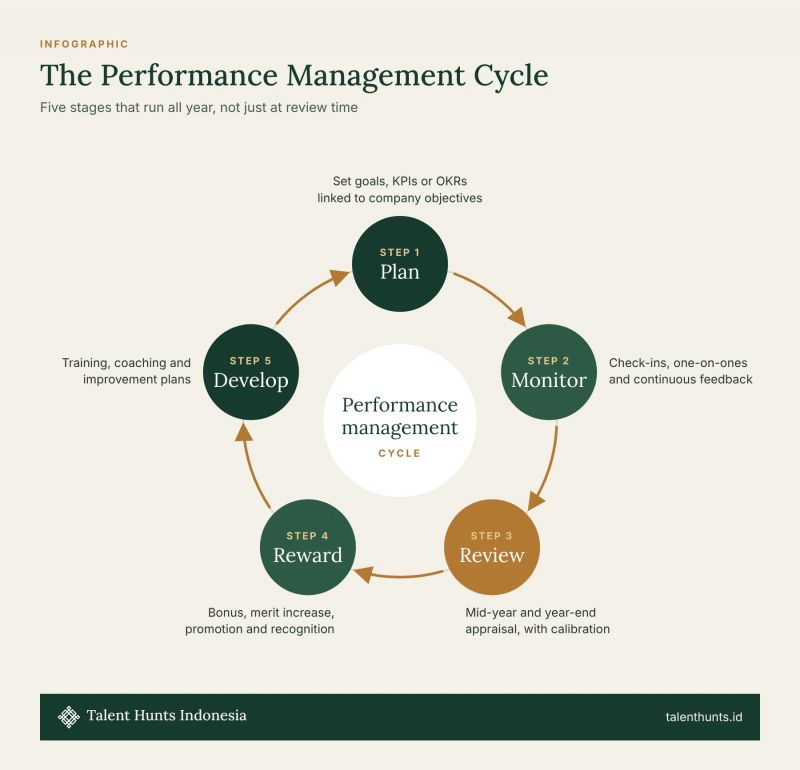
A performance management system runs as a five-stage cycle: plan, monitor, review, reward and develop. The end of one cycle feeds the plan for the next.
1. Planning
The manager and employee agree on what success looks like for the period, usually a year broken into quarters. Goals cascade from company objectives to team and individual targets, and each goal has a clear measure, such as a KPI or key result. Planning also covers expected behaviours, for example collaboration or customer focus.
2. Monitoring
Progress is tracked throughout the period, not only at the end. This happens through regular check-ins, dashboards and informal feedback. If priorities change, goals are adjusted here instead of being judged later against targets that no longer make sense.
3. Review
At set points, typically mid-year and year-end, performance is formally assessed. This is where the performance appraisal sits. A fair review combines results (what was achieved) with behaviours (how it was achieved), and draws on evidence collected during monitoring rather than memory.
4. Reward
Review outcomes are linked to consequences: merit increases, bonuses, promotions and recognition. When rewards are clearly tied to the review, employees see that performance matters. Our guide on how to create an effective employee bonus plan covers this stage in more detail.
5. Development
The review also shows where each person needs to grow. Development plans cover training, coaching, stretch assignments or, where performance is below expectations, a structured improvement plan. These development goals then go into the next planning stage, and the cycle starts again.
Key Elements of an Effective Performance Management System
Whatever the company size, an effective PMS needs four elements.
1. Clear goals: KPIs or OKRs. Goals turn strategy into individual work. KPIs (Key Performance Indicators) suit roles with stable, measurable output, such as sales, production or customer service. OKRs (Objectives and Key Results) suit roles where the focus is change or growth, such as product or business development. Many companies use KPIs for business-as-usual targets and OKRs for a few ambitious priorities. Either way, keep each person to a manageable number of goals, typically three to seven.
2. Continuous feedback. Feedback should arrive close to the moment it matters, not six months later. This includes recognition for good work and early correction when something goes off track. Some companies add peer or 360-degree feedback for leadership roles.
3. Regular one-on-one meetings. A short, recurring conversation between manager and employee, for example 30 minutes every two weeks or monthly, is the engine of the monitoring stage. Good one-on-ones cover progress against goals, obstacles, support needed and development, not only status updates.
4. Calibration. Before final ratings are confirmed, managers meet to compare and align ratings across teams. Calibration reduces the gap between strict and lenient managers and makes reward decisions fairer. It is especially important when ratings drive bonuses or promotions.
Underpinning all four is documentation: goals, feedback and review notes recorded in one place, whether a spreadsheet or dedicated software, so decisions are based on evidence.
Performance Management vs Performance Appraisal
Performance appraisal is one step inside performance management. The appraisal looks back at a period; performance management looks forward and runs all year.
Aspect | Performance appraisal | Performance management |
|---|---|---|
Scope | One stage: evaluating past performance | Full cycle: plan, monitor, review, reward, develop |
Frequency | Once or twice a year | Continuous, with formal reviews at set points |
Focus | Rating and judging results | Improving performance and aligning it with business goals |
Direction | Backward-looking | Forward-looking |
Feedback | Mostly top-down, at review time | Two-way and ongoing, through check-ins and one-on-ones |
Main owner | HR, with the manager filling in the form | Managers and employees, with HR designing the system |
Typical output | A score that informs pay and promotion | Goals, development plans and reward decisions |
Appraisal methods still matter, because the review stage needs a fair way to assess people. Our article on 4 types of performance appraisal methods a company can adopt compares options such as management by objectives (MBO) and 360-degree feedback.
How to Implement a Performance Management System
Implementing a PMS works best as a phased project, starting with one cycle and improving it each year.
- Start from business goals. Translate the company's annual objectives into department goals before setting individual targets. Without this link, people can hit their KPIs while the business misses its targets.
- Define roles and expectations. Make sure each position has an up-to-date job description and clear success measures. A PMS cannot be fair if people do not know what their job is.
- Design the cycle and calendar. Decide when goals are set, how often check-ins happen, when reviews take place and when reward decisions are made. Align the review calendar with the budget and bonus cycle.
- Choose a rating approach. Keep scales simple, for example a five-point scale with clear definitions, and decide how results and behaviours are weighted.
- Train managers first. Managers run the system day to day. Train them on setting goals, giving feedback, running one-on-ones and avoiding rating bias before launch.
- Communicate to employees. Explain why the system exists, how it works and how it connects to pay and development. Transparency builds trust.
- Pilot, then roll out. Test the cycle in one or two departments, fix what does not work, then expand company-wide.
- Link to rewards and development. Make sure review results actually drive bonuses, merit increases, promotions and training. If nothing changes after a review, the system loses credibility.
- Review the system every year. Collect feedback from managers and employees, and look at whether ratings predicted performance and retention.
Choosing performance management software
Many companies start with spreadsheets and move to software as they grow. When comparing PMS software, look for:
- Goal setting and tracking that supports KPIs, OKRs or both
- Check-in and one-on-one templates with shared notes
- Continuous and 360-degree feedback
- Review forms you can configure, plus calibration views for HR
- Integration with your HRIS and payroll, so ratings flow into reward decisions
- Bahasa Indonesia support and local data storage, if your workforce or policies require them
- Reporting that shows rating distribution by team and manager
Software makes a good process faster, but it does not fix a poorly designed one. Settle the cycle, goals and roles first, then choose the tool that fits them.
Common Challenges and How to Solve Them
Challenge | What it looks like | How to fix it |
|---|---|---|
Goals not linked to strategy | Employees hit targets but the business misses its plan | Cascade company goals to teams before individual goal setting |
Too many or vague goals | Ten-plus goals per person, or targets like "improve quality" | Limit to three to seven goals, each with a clear measure |
Year-end surprises | Employees learn about problems only at the annual review | Hold regular one-on-ones and give feedback when issues arise |
Rating bias | Lenient managers rate everyone highly; recent events outweigh the whole year | Train managers, keep evidence during the year, and run calibration |
No consequences | High and low performers receive similar rewards | Tie bonuses, merit increases and promotions clearly to review results |
Admin burden | Managers see the PMS as paperwork for HR | Keep forms short and use simple tools; show managers how it helps their team |
Low trust | Employees see the process as unfair or political | Explain criteria openly, allow two-way feedback, and offer a route to raise concerns |
Most of these problems come back to managers. A performance management system is only as good as the people running it, which is why hiring and developing strong managers matters as much as the system design.
Conclusion
A performance management system is far more than an annual appraisal. It is a year-round cycle of planning, monitoring, review, reward and development that links each person's work to business goals. Get the basics right (clear goals, regular feedback, one-on-ones and calibration), train your managers, and make sure review results lead to real rewards and development.
Even the best system depends on the people in it. Talent Hunts Indonesia helps companies hire managers and leaders who set clear goals, coach their teams and build a performance culture, using our HUNTS Framework™ to assess fit for both the role and the organisation.